HSC GPA vs SSC GPA: What's Actually Different About the Calculation
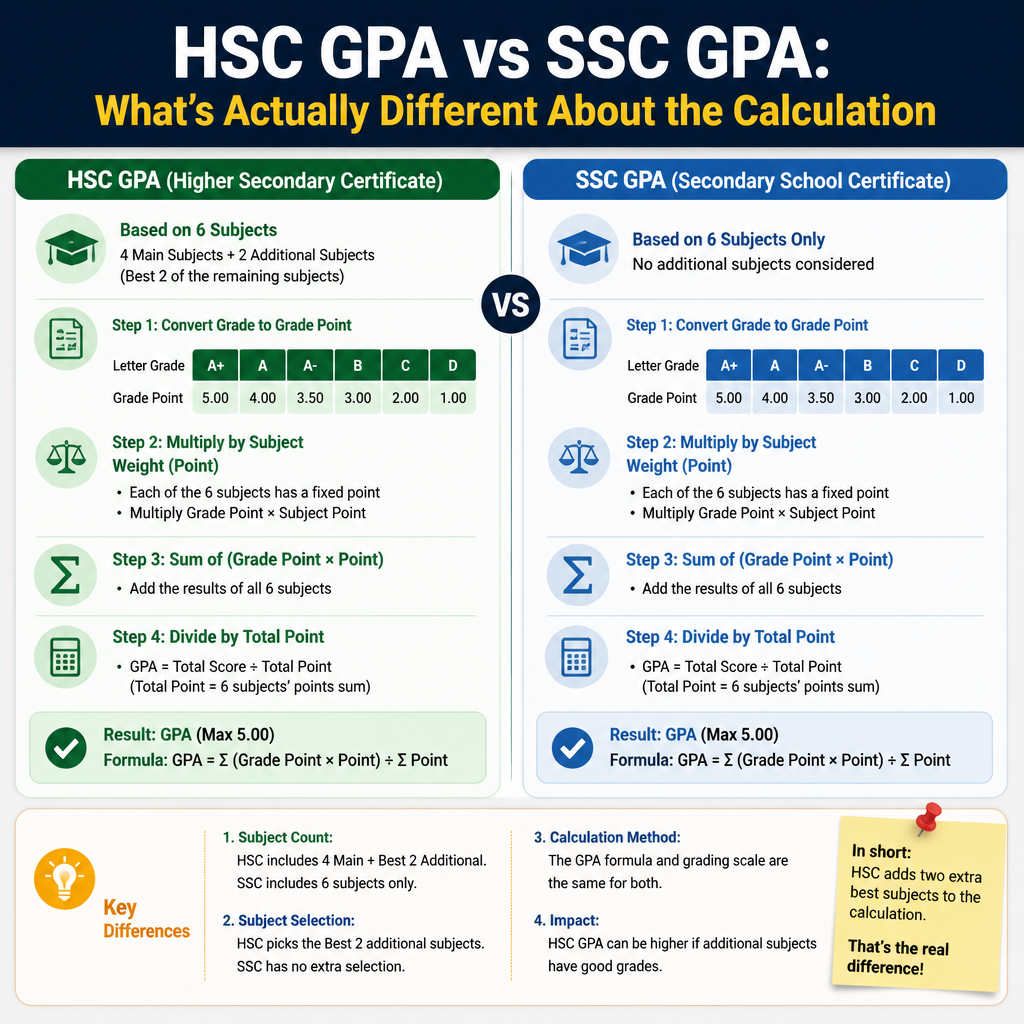
The Assumption Of Consistency
Most students in Bangladesh finish their SSC exams with a firm grasp on how their GPA is calculated. You take your individual grade points, you factor in the fourth subject bonus, and you divide by the remaining number of subjects. It feels like a repeatable formula. So, when the Higher Secondary Certificate exams roll around two years later, the natural instinct is to assume the math is identical.
We see this often. You take your marks, plug them into the mental model you built at age 16, and expect the result to be your ticket to university admission. But the transition from SSC to HSC is not just a jump in the difficulty of the material; it is a fundamental shift in how your academic identity is structured and counted.
The difference in calculation is not a radical reimagining of mathematics. It is a difference in categorization and weight. If you approach your HSC GPA the way you approached your SSC GPA, you are likely to miscalculate your threshold for university eligibility or, worse, misunderstand how critical your optional subject really is at this higher level.
The Compulsory Framework Of HSC
At the SSC level, you are dealing with a broad, foundational set of subjects. Everyone takes nearly the same core curriculum, regardless of their stream. HSC narrows the focus significantly, which changes the denominator in your GPA equation.
In the HSC curriculum, we have three absolute compulsory subjects: Bangla, English, and Information and Communication Technology. These are the universal pillars. No matter if you are in Science, Humanities, or Business Studies, these are on your transcript.
However, unlike SSC, where these subjects might feel like a continuation of general schooling, the HSC versions are split into papers. Bangla I and II, English I and II. While they are graded as a whole, the complexity of managing these two-paper subjects often trips students up when they try to estimate their points before the official result is published.
The Group Subject Shift
The real divergence begins with the group subjects. In SSC, you are still testing the waters of your chosen field. In HSC, your group subjects define your entire future academic career.
For a Science student, these are Physics, Chemistry, and Biology or Higher Mathematics. For Business Studies, it is Accounting, Management, and Finance or Marketing. Humanities students have their own specific trio.
The mistake most people make is treating these six papers (three subjects, two papers each) as individual units of calculation. They are not. The board combines paper I and paper II to generate a single grade for that subject. If you score an A+ in Physics I but a B in Physics II, your total points for Physics are averaged out according to a specific mark range. This combined grading is where many students lose their grip on the final number.
The Fourth Subject Advantage In HSC
This is the area where we see the most confusion. Every student chooses a fourth subject. In Science, if you take Biology as a main group subject, Higher Math usually becomes your fourth subject, or vice versa.
The rule for the fourth subject in Bangladesh is that any point above 2.00 is considered a bonus. If you get an A+ (5.00 grade points) in your fourth subject, only 3.00 of those points are added to your total grade point sum.
Wait, why 3.00? Because the first 2.00 points are considered the baseline passing requirement that doesn't contribute to your "extra" score.
In some ways, this mirrors the SSC system, but at the HSC level, the impact is felt more acutely because there are fewer total subjects to divide by. When the denominator is smaller, that 3.00-point bonus carries significantly more weight in pulling your average toward a 5.00 than it did in your SSC days.
A Worked Example For Science Students
To illustrate how this actually plays out, let's look at a hypothetical Science group student.
- Bangla (5.00)
- English (4.00)
- ICT (5.00)
- Physics (5.00)
- Chemistry (5.00)
- Biology (4.00)
- Higher Math (4th Subject: 5.00)
Total subjects counted for the division: 6 (Bangla, English, ICT, Physics, Chemistry, Biology). Note that the 4th subject is never included in the divisor.
The calculation starts by adding the points of the first six subjects: 5+4+5+5+5+4 = 28.00. Next, we take the fourth subject bonus. Since the student got an A+ (5.00), we subtract 2.00, leaving a bonus of 3.00. Total points: 28.00 + 3.00 = 31.00. GPA: 31.00 divided by 6 = 5.166.
But wait. You cannot have a GPA higher than 5.00. So, despite the math leading to 5.16, the official result is 5.00.
Now, imagine if that student got a B (3.00) in English. New sum: 5+3+5+5+5+4 = 27.00. Add the 3.00 bonus: 30.00. GPA: 30.00 divided by 6 = 5.00.
In this scenario, the fourth subject literally saved the student's Golden A+. At the HSC level, your fourth subject acts as a primary safety net because the curriculum is significantly more specialized. If you need a more granular breakdown of how these rules evolved from the earlier stages of the curriculum, you might want to read our article on ssc-gpa-calculation-explained-bangladesh to see where the logic began.
Why Hand Calculation Is Risky
The reason we built the HSC GPA Calculator is that humans are remarkably bad at accounting for failure conditions. If you fail in one paper of a two-paper subject, the entire subject is a failure. You cannot "average out" a failing grade in English II with a high grade in English I if the total marks don't cross the pass threshold for both.
Furthermore, students often forget that the divisor excludes the fourth subject. They see seven subjects on their list and divide by seven. This results in a GPA that is significantly lower than reality, causing unnecessary stress during the wait for admission results.
The division is always by the number of mandatory and elective group subjects (usually 6). The fourth subject is purely additive to the numerator, never part of the denominator.
How The Tool Simplifies The Logic
Our HSC GPA Calculator is designed to prevent these specific mathematical errors. Instead of asking you to do the "minus 2" logic for your optional subject, the tool asks you to define which subject is your fourth and what grade you received.
It also accounts for the specific combinations of Science, Commerce, and Arts. The structure of an HSC result includes practical marks, MCQ marks, and written marks. While our calculator works on the final grade point per subject, it ensures the weighting of the fourth subject is applied precisely as the Education Board of Bangladesh dictates.
We do not believe in making things more complicated than they need to be. The tool takes your letter grades (A+, A, A-, B, C, D, F) and converts them to the corresponding points (5, 4, 3.5, 3, 2, 1, 0) before performing the aggregation.
The Role Of The Board
It is crucial to remember that while our tools are built based on the official guidelines of the Directorate of Secondary and Higher Education (DSHE), the Education Board serves as the final, authoritative source. Every year, there can be minor adjustments in how grace marks are applied or how subjects are weighted in specific circumstances.
Using an independent calculator gives you a reliable estimate and a clear understanding of your standing, but your official mark sheet remains the legal document for university applications.
If you are currently looking at your marks and wondering if you have done enough to clear the 4.50 or 4.80 threshold for a specific university, don't rely on a napkin calculation. The risk of miscounting the fourth subject bonus or misapplying the divisor is too high when your admission eligibility is on the line.
Try it: https://kind-cloud-generator.lovable.app/tools/hsc-gpa-calculator
Try our related free tools
Put this guide into practice with our free image compressor, PDF merger, and AI grammar checker — all run in your browser with no signup.
Related articles
The 4th Subject Problem: A Common SSC/HSC GPA Calculation Mistake
The Bangladesh secondary and higher secondary education systems operate on an elegant grading system that, unfortunately, feels like a riddle wrapped in an enigma the moment you sit down with a pencil to calculate your final GPA. If you were taught that a Grade Point Average is s
How SSC GPA Is Actually Calculated in Bangladesh (With a Worked Example)
The Secondary School Certificate, or SSC, is the first major academic gatekeeper in Bangladesh. It determines which college you can enter and sets the tone for your future career trajectory. Yet, despite its importance, the way the final Grade Point Average is calculated remains
Why Two Different GPA Calculators Sometimes Give You Different Numbers
You have your transcript in your hand or your marks saved in a spreadsheet. You find a GPA calculator online, punch in your numbers, and get a 4.88. Feeling a bit skeptical, you open a different brand of calculator, input the exact same grades, and it spits out a 5.00. Suddenly,
University CGPA Explained: Why It's Not Just an Average of Your Semester GPAs
Most university students spend four years chasing a number without actually understanding how that number is manufactured. We have seen it happen a thousand times: a student finishes their fourth semester, looks at their individual GPA results for each term, adds them up, and div
About the author
Instant Access Tools Team
Reviewed by the Instant Access Tools Editorial Team
Our editorial team builds and reviews free browser-based tools for PDFs, images, calculators and AI utilities. Every guide is written by writers who use the tools themselves and reviewed for accuracy before publication.