Clearscope Pricing 2026: Plans & Costs
Disclosure: This post contains affiliate links. If you buy through them, we may earn a commission at no extra cost to you.

Clearscope is the content optimization tool that agencies whisper about and freelancers flinch at when they see the price tag. Everyone agrees its briefs and grading reports are excellent — almost nobody agrees the cost is painless. That tension is exactly what this clearscope pricing breakdown is here to resolve: what each plan really costs, how the report-credit system works, whether the annual billing saves you anything meaningful, and the hidden costs that catch first-time buyers off guard.
I have run Clearscope reports for real client projects and compared them side by side with Surfer, Frase, and plain Google Docs with a good brief. I know where Clearscope earns its premium and where it is just expensive. If you are deciding whether this tool deserves a line in your budget, this guide gives you every number that matters — with prices hedged where they need to be, because Clearscope changes things quietly.
Quick Verdict: What Clearscope Pricing Boils Down To
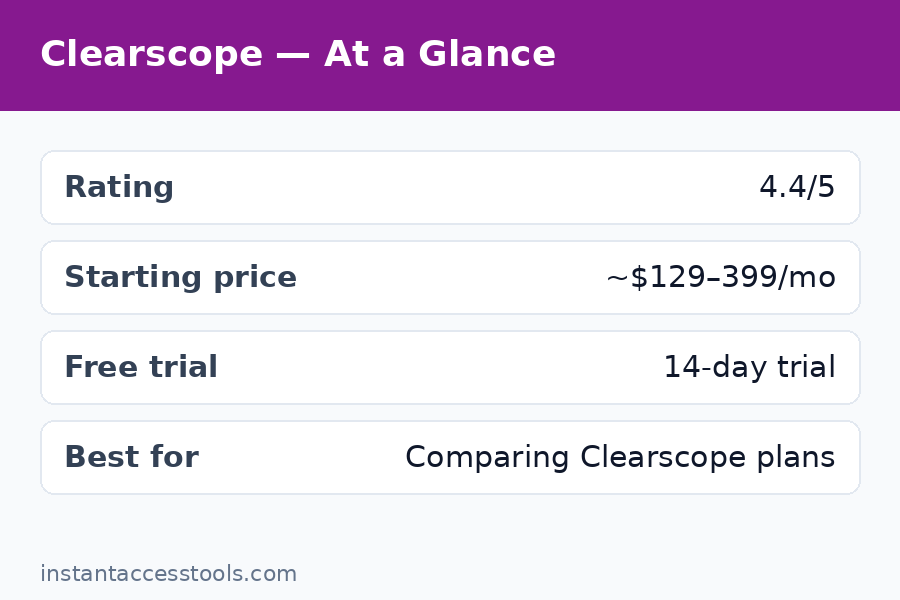
The short version: Clearscope pricing starts at around $189/month for the Essentials plan at the time of writing — check the official site for current pricing. That gets you a monthly allowance of content reports (credits), with Professional around $399/month and Enterprise on custom quotes. There is no traditional free trial, but the annual plan cuts roughly 17% off. It is the most expensive mainstream content optimization tool per report, and it is worth it if you sell premium content — otherwise Surfer or Frase give you 80% of the value at a fraction of the cost.
How Clearscope Pricing Works: The Credit Model Explained
Before the numbers, you need to understand the model, because clearscope credits are the single thing people misunderstand most. Clearscope does not charge per seat, per project, or per keyword. It charges per report — and every report you run consumes credits from your monthly allowance.
Here is how it works in practice. You pick a target keyword, Clearscope pulls the top-ranking pages for it, analyzes the terms they share, and generates a content brief and an optimization report. That report costs one “report credit” (the exact terminology shifts — sometimes called “reports” in the plan features). Your plan gives you a fixed number per month: use them or lose them, since unused credits generally do not roll over to the next month. That is the first thing to know about clearscope pricing: you are buying a monthly report allowance, not unlimited usage.
Why does Clearscope price this way? Because each report hits Google’s SERPs and runs heavy NLP analysis on dozens of competing pages, and that compute is not cheap. The model is honest in one sense — you pay for what you consume — but it punishes exploration. Running a report for a keyword you are “just curious about” burns the same credit as the report for the money page you will actually optimize. I learned this the expensive way in my first month: I ran exploratory reports for a dozen long-tails I never wrote for, and watched a third of my monthly allowance evaporate in a week.
The practical takeaway is simple: know your monthly content volume before you pick a plan. If you optimize four posts a month, a small allowance is fine. If you run an agency producing thirty briefs a month, you need to do the per-report math — because that is where Clearscope pricing either makes sense or falls apart.
- Each report = 1 keyword analysis, covering one page you optimize or brief.
- Credits reset monthly and typically do not roll over.
- Draft revisions and re-runs within the same report generally do not burn extra credits — one report covers iterating on that document.
- Adding seats or users is handled separately from reports on higher tiers; check the current plan page for how seats are bundled.
Clearscope Pricing Plans: Every Tier Explained
At the time of writing, Clearscope offers three clearscope plans — Essentials, Professional, and Enterprise. The jump between them is steep, so let me walk through each with the kind of detail the pricing page glosses over.
| Plan | Approx. monthly cost* | Who it fits |
|---|---|---|
| Essentials | starts at around $189/month | Solo SEOs, freelancers, small blogs publishing a handful of optimized posts monthly |
| Professional | starts at around $399/month | Agencies and in-house teams running content at volume, needing more reports and collaboration |
| Enterprise | custom quote | Large organizations needing SSO, dedicated support, custom report volumes, and procurement-friendly terms |
*Approximate US pricing at the time of writing — Clearscope revises its plans periodically, so check the official site for current pricing before you budget.
Essentials: The Clearscope Essentials Cost, Up Close
So what is the actual clearscope essentials cost, and what does it buy you? At the time of writing, Essentials starts at around $189/month on monthly billing — check the official site for current pricing — and it is aimed squarely at individuals and small teams. You get a limited monthly report allowance (the exact number has shifted over the years; it sits in the dozens), one user seat, the core brief and optimization grading, the Google Docs add-on, and the WordPress integration.
Here is my honest read after using it: Essentials is a luxury tool for a solo operator. $189 a month is real money when you are a freelancer, and it only earns its keep if you are publishing — and getting paid for — optimized content every single week. The math that works: if you charge $300+ per optimized article, one or two client posts a month covers the subscription. The math that does not: a hobby blog publishing two posts a month, where you would be paying roughly $95 per report. That is the moment most people should look at Frase instead, and my frase pricing breakdown shows exactly where the value line sits.
The limitation that stings most on Essentials is the single seat. The moment you want a writer to work inside Clearscope with you — sharing grades, reviewing terms — you are looking at Professional. Clearscope knows this; the seat ceiling is the real upsell engine, not the report allowance.
Professional: For Teams That Live in Content
Professional, starting at around $399/month at the time of writing — check the official site for current pricing — is the tier Clearscope’s own pricing page quietly points most serious buyers toward. The headline change is volume: a much larger monthly report allowance (historically in the hundreds), multiple seats so your strategists and writers can collaborate in the same workspace, and deeper workflow features like content inventory tracking and shareable brief links for freelancers who do not need a login.
For agencies, this is where the per-report economics flip. If your team runs 100+ reports a month, Professional’s effective cost per report drops into the low single dollars — suddenly Clearscope is not expensive at all; it is one of the cheapest line items on a content retainer. I have seen agencies build their entire brief-to-delivery workflow around it: strategist generates the brief, shares the link with the writer, writer drafts in Google Docs with the add-on grading live, editor checks the final grade before publishing. When the tool is the assembly line, $399 a month is a rounding error.
The catch is commitment. Professional only makes sense at real volume. A three-person agency running 20 reports a month is paying luxury prices for a tool they underuse — and the annual version of that mistake costs nearly $4,000. Be honest about your throughput before you upgrade.
Enterprise: The “Call Us” Tier
Enterprise is Clearscope’s custom-quoted tier for organizations that need procurement checkboxes: SSO/SAML, custom security reviews, dedicated customer success, custom report volumes, and negotiated contract terms. Pricing is quote-based, which in practice means it starts well above Professional and scales with your report volume and seat count.
Who actually needs this? In-house SEO teams at large publishers, e-commerce brands with hundreds of product and category pages, and agencies white-labeling reports at scale. If you are reading this wondering whether you need Enterprise, you almost certainly do not — but if your legal team requires a DPA and security questionnaire before any SaaS purchase, this is the only tier that accommodates that dance.
Check current Clearscope plans on the official site
What Clearscope Credits Get You (and How Fast You Burn Them)
Let me make the credit math concrete, because “a monthly report allowance” stays abstract until you map it to a workflow. A single report in Clearscope covers the full lifecycle of one content piece: the keyword research snapshot, the shareable content brief, the live optimization grade as you draft, and the final score check. One credit, one page, start to finish.
Where people burn credits faster than expected:
- Keyword exploration. Every keyword you analyze costs a credit, even if you decide not to write the piece. Do your keyword shortlisting in a cheaper tool (or a free one), and bring only the finalists to Clearscope. This one habit probably saved me 30% of my allowance.
- Multiple variants. Targeting the same keyword for two different pages (say, a blog post and a product page)? That is two reports. Clearscope analyzes per-URL intent, which is correct behavior, but it doubles the cost of covering one keyword from two angles.
- Client churn. Agency folks: when a client pauses mid-project, the reports you already ran stay burned. Build a small buffer into your plan choice — running your allowance at 100% every month leaves no room for the real world.
- Re-briefs. Refreshing an old report for a content update is usually fine within the same report, but if the SERP has shifted dramatically and you start fresh, expect a new credit.
The flip side: one report goes a long way. Because the brief, the live grading, and the final check all live inside one credit, a single report genuinely covers the whole production cycle of an article. I have never felt the credit was “used up” by a legitimate piece of work — only by my own exploratory waste.
Is There a Clearscope Free Trial?
Here is the part that surprises people: there is no clearscope free trial in the traditional sense — no 7-day, no credit-card-required self-serve test drive, at least at the time of writing. Clearscope sells through demos and sales conversations, especially on Professional and Enterprise. Essentials historically has not offered a trial either, which makes it one of the few mainstream SEO tools you essentially have to buy sight unseen.
That said, there are three ways to kick the tires before committing:
- Book a demo. Clearscope’s sales team will walk you through a live report on a keyword of your choosing. It is a sales call, obviously, but the demo itself is genuinely informative — ask them to run a report for one of your keywords so you see real data, not a cherry-picked example.
- Ask for a sample report. In my experience, asking directly gets you a shared report link you can poke around in. It will not let you grade your own draft, but you will see the term analysis and brief structure.
- Start monthly, not annual. This is the closest thing to a trial: pay for one month of Essentials, run it hard for 30 days, and cancel if it does not earn its keep. The monthly plan is your risk management.
Is the lack of a trial a red flag? Not exactly — it is a positioning choice. Clearscope is priced and sold like enterprise software, and enterprise software rarely has a “try free” button. But it does mean you should do your homework (this guide included) before the first invoice.
Clearscope Hidden Costs Nobody Warns You About
The sticker price is never the whole story. These are the costs that surprised me or people I have talked to:
- The seat trap. Essentials includes one seat. The moment a second person needs real access, you are either sharing a login (against the terms, and a security headache) or jumping to Professional. Budget for the team you will have in six months, not the team you have today.
- Onboarding time. Clearscope is easy to use but hard to use well. Getting writers to actually follow brief grades, calibrating what an “A+” means for your niche, building the habit of briefing before drafting — that is weeks of process change. The tool does not do this for you.
- Report waste. As covered above, exploratory reports burn credits. At Essentials volumes, every wasted report is a few dollars of subscription value in the bin.
- The annual lock-in. The annual plan is cheaper per month (see below), but it is a 12-month commitment. If your content volume drops in month four, you cannot downshift. Clearscope is not month-to-month-friendly in spirit, even where monthly billing exists.
- Opportunity cost of over-optimization. This one is subtle but real: chasing an A++ on every draft can flatten your writing into keyword-stuffed sameness. I have seen writers sacrifice genuinely good angles to satisfy the grader. The tool is a guide, not an editor — budget some editorial judgment on top.
Clearscope Annual Discount and Other Ways to Save
Yes, there is a clearscope annual discount — paying yearly instead of monthly knocks roughly 15–20% off the per-month price at the time of writing (Clearscope has historically framed it as two months free). On Essentials, that is the difference between roughly $189/month and roughly $159/month; on Professional, the annual savings run into the hundreds of dollars per year.
Before you take it, run this checklist:
- Will you use it for 12 straight months? If your content calendar has seasonal dips or you are testing the tool, stay monthly for the first quarter. The discount is only a discount if you would have paid all twelve months anyway.
- Is your volume stable? Annual locks your report allowance. If you are about to scale up (and might need Professional) or scale down, the flexibility of monthly billing is worth more than the discount.
- Can you negotiate? On Professional and especially Enterprise, the listed annual price is a starting point. Agencies committing to multi-seat deals have room to ask for better terms — the worst they say is no.
Other ways to pay less without downgrading the tool itself: consolidate your keyword research into a cheaper tool and reserve Clearscope strictly for final-stage briefs and grading (this is the single biggest saver); share briefs via links with freelance writers instead of buying them seats; and time your signup — Clearscope occasionally runs promotions around major SEO conferences and year-end.
See if Clearscope fits your budget — view current plans
Clearscope vs Surfer Pricing: How the Two Compare
You cannot talk about clearscope pricing without the Surfer comparison, because almost everyone choosing between content optimization tools ends up here. When I lined up clearscope vs surfer pricing side by side, the gap was stark: Surfer’s entry plan starts at roughly half of Clearscope’s Essentials (around $79–$89/month at the time of writing — check the official site for current pricing), and Surfer’s credit model is more flexible, with content editor credits that can stretch further for low-volume users.
So why would anyone pay double for Clearscope? Three reasons I have seen hold up in practice: the brief quality (Clearscope’s term analysis and brief structure are genuinely a cut above — strategists I trust prefer them), the cleaner interface (less clutter, faster to train writers on), and the agency workflow (shareable briefs and the Google Docs add-on are smoother). Surfer counters with more features per dollar — keyword research, SERP analysis, AI writing, site auditing — a whole SEO suite where Clearscope is a specialist.
The pricing verdict: if content optimization is one tool among many in your stack, Surfer’s price is hard to argue with. If briefs and grading are the core of your content operation and you will feel the quality difference daily, Clearscope’s premium is defensible. I go deeper on the full feature comparison in my clearscope vs surfer seo head-to-head, and my full clearscope review covers where each dollar goes.
Frequently Asked Questions
How do the clearscope plans differ on reports and seats?
The core differences are monthly report allowance and user seats. Essentials is built for one user with a modest report allowance; Professional multiplies both for teams; Enterprise customizes everything with a quote. All tiers include the same fundamental brief-and-grade engine — you are paying for volume and collaboration, not a different algorithm.
What is the clearscope essentials cost in 2026?
The clearscope essentials cost starts at around $189/month on monthly billing at the time of writing — check the official site for current pricing. Annual billing lowers the effective monthly rate by roughly 15–20%. Essentials includes a limited monthly report allowance and a single seat, aimed at solo SEOs and freelancers.
How do clearscope credits work — do unused credits roll over?
Each content report consumes one credit from your monthly allowance, and unused credits generally do not roll over — they reset each billing cycle. Iterating on the same report (re-grading drafts, refreshing the brief) typically does not burn additional credits. Plan your monthly content volume before choosing a tier so you are not paying for reports you never run.
Is there a clearscope annual discount?
Yes. Paying annually instead of monthly saves roughly 15–20% (historically framed as about two months free) at the time of writing. It is worth it only if you are confident about twelve months of steady usage — otherwise the flexibility of monthly billing outweighs the savings.
Which is cheaper: clearscope vs surfer pricing?
Surfer is significantly cheaper at the entry level — roughly half the price of Clearscope Essentials at the time of writing. Clearscope’s premium buys better brief quality and a cleaner workflow, in my experience, while Surfer bundles more features (keyword research, AI writing, audits) per dollar. Choose based on whether brief quality or feature breadth matters more to your process.
Is there a clearscope free trial or money-back guarantee?
There is no traditional self-serve clearscope free trial at the time of writing. Your options are booking a demo, requesting a sample report, or subscribing monthly for one month as a paid trial. Check the current terms on the official site, since trial and refund policies can change.
Final Verdict: Is Clearscope Pricing Worth It in 2026?
Clearscope pricing is premium, unapologetically so — and after using it on real projects, I think the price is fair but not friendly. Fair, because the briefs genuinely produce better first drafts and the grading genuinely catches optimization gaps; the tool does the one job it claims to do better than anything else I have tested. Not friendly, because the credit model punishes curiosity, there is no free trial, and the seat ceiling pushes growing teams into a big price jump fast.
Here is who should pay: agencies and in-house teams producing optimized content at volume, freelancers charging premium per-article rates, and anyone whose content operation already runs on briefs. Here is who should not: hobby bloggers, anyone publishing fewer than four optimized posts a month, and teams that need keyword research and auditing bundled in — Surfer or Frase will serve you better for less.
My advice: start with one month of Essentials, run it hard, and measure whether your drafts actually get better faster. If the answer is yes, the annual plan’s discount makes the second year genuinely reasonable. If the answer is no, you have spent ~$189 to learn something valuable — which is still cheaper than a year of the wrong tool.