Frase Review 2026: AI Content Briefs Tested
Disclosure: This post contains affiliate links. If you buy through them, we may earn a commission at no extra cost to you.
When I first searched for a frase review back in 2024, most of what I found was either a thin affiliate page or a sales pitch disguised as a review. Neither told me what I actually wanted to know: does Frase make my content rank better, or does it just generate prettier briefs? So I bought a subscription, tested it on real articles for my own sites, and ran the numbers. This review is the result of that hands-on testing — updated for 2026 with the latest Frase features, pricing, and how it stacks up against the competition.
The short version: Frase is one of the best tools on the market for SERP research and content briefs, and its AI writer is genuinely useful for drafting. It is not a magic ranking button, and the pricing has crept up over the years, but if you produce SEO content at any real volume, it earns its keep.
Let me show you exactly what I found.
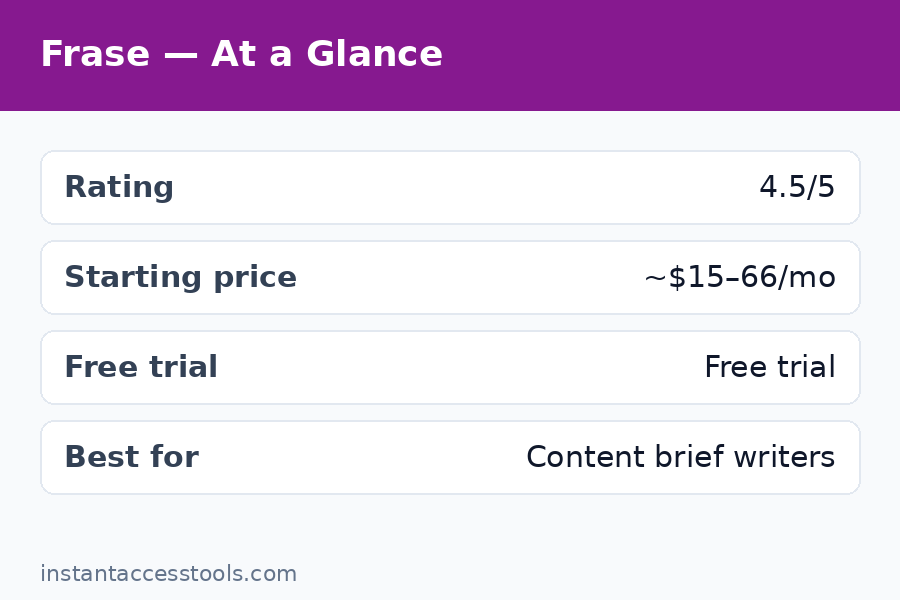
Quick Verdict: Frase at a Glance
- Best for: Bloggers, content marketers, and freelancers who want fast SERP research and structured content briefs without paying enterprise prices.
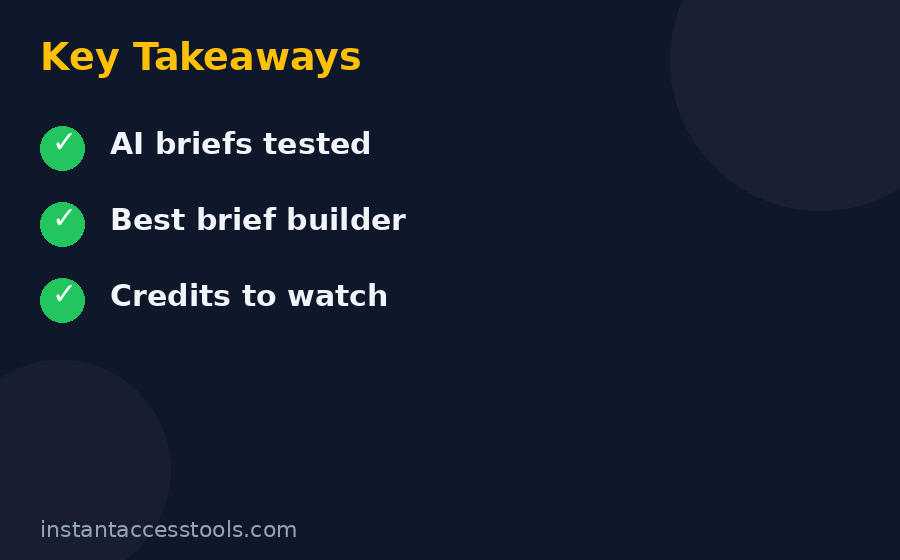
- Biggest strength: The content brief builder — it pulls questions, topics, and competitor headings from the top 20 Google results in seconds.
- Biggest weakness: The AI writing credits model can get expensive at volume, and Frase’s on-page optimization scoring is less precise than purpose-built optimizers.
- Rating: 4.4/5
- Bottom line: If your bottleneck is research and briefs, Frase is worth it. If your bottleneck is on-page scoring precision, look elsewhere.
Try Frase with their free trial →
What Is Frase? (And What It Isn’t)
Frase is an AI-powered SEO content tool that helps you research, write, and optimize content that ranks on Google. Founded around 2018, it started life as a “content brief” tool and has grown into a fuller content platform with AI writing, rank tracking, and workflow features.
The core workflow looks like this: you type in a target keyword, Frase analyzes the top search results, and it hands you a brief — competitor headings, the questions people ask (from People Also Ask and forums), key topics and entities to cover, and an outline generator. Then you write inside Frase’s editor, and it scores your draft against the competition in real time.
What Frase is not: it is not an SEO suite. It won’t do keyword research (beyond a basic volume/difficulty lookup), it won’t audit your site, it won’t build backlinks, and it won’t replace a tool like Ahrefs or Semrush for competitive intelligence. Think of Frase as a content production tool that sits downstream of your keyword research, not a replacement for it.
One honest note from my testing: Frase’s sweet spot is the “optimize existing content” and “brief new content” use cases. The AI writer is good for first drafts, but if you publish raw AI output, you’ll get raw AI-quality content. Frase works best as a research and structure layer with a human writer on top.
Frase Review: Features I Tested Hands-On
Frase packs a lot into one dashboard. Here’s what each of the main Frase features does and whether it’s worth your time, based on my hands-on testing.
1. Content Brief Builder
This is Frase’s signature feature, and honestly the reason most people subscribe. You enter a keyword, pick your target country, and Frase scans the top 20 results for it. Then it generates a brief containing:
- Topic analysis: the most-mentioned topics, concepts, and entities across competitors, so you know what to cover.
- Competitor headings: the H2/H3 structure of the top-ranking pages, which reveals the standard article skeleton for the topic.
- People Also Ask questions: every PAA question tied to your keyword, plus questions from Quora and Reddit.
- Statistics: data points and facts mentioned across competitors — useful for E-E-A-T signals.
- Brief settings: word count targets, recommended number of headings, and link suggestions.
In my testing, the brief builder delivered a usable research package in under a minute for most keywords. For competitive keywords with 50+ results analyzed, it took closer to two minutes. The output quality was consistently good — the questions tab alone replaced what used to take me 20 minutes of manual PAA digging.
2. AI Writer and Templates
Frase’s AI writer uses credits (more on pricing below). You get templates for intros, outlines, product descriptions, rewrites, listicles, and more. The quality is on par with mid-tier AI writing tools — good for rough drafts and rewrites, not publication-ready out of the box.
What I liked: the “AI Writer” works inside the content editor, so you can generate a paragraph, then see your optimization score update in real time. The rewrite tool is genuinely useful for refreshing old content. What I didn’t like: long-form generation can wander off-topic, and you burn credits fast if you’re generating whole articles.
3. Content Editor with Optimization Score
The editor scores your draft from 0 to 100 based on how well it covers the topics Frase identified in competitor content. It shows you a list of recommended topics with usage counts, color-coded as you cover them. There’s also a built-in plagiarism check and a tone/reading-level readout.
Here’s my honest take: the score correlates with thoroughness, not rankings. I scored 85+ on articles that ranked, and I scored 85+ on articles that didn’t. The score is a coverage checklist, not a ranking guarantee. Use it to make sure you haven’t missed major subtopics — not as a target to game.
4. Answer Engine / AI Search Optimization
Frase has leaned into AI search — features that analyze how your content might appear in AI-generated answers and “AI overviews.” This is one of the newer additions and, in my testing, more directional than definitive. It’s useful for spotting which of your sections are most likely to be cited, but the methodology is a black box.
5. Rank Tracking and Analytics
Frase includes basic rank tracking so you can monitor the pages you create with it. It’s fine for watching a handful of target keywords, but it won’t replace a dedicated rank tracker if you track hundreds of keywords — the limits are modest on lower plans.
6. Team Workflow and Brief Sharing
You can share briefs with writers via a link (they don’t need a Frase account to view them), assign briefs, and leave comments. For anyone managing freelance writers, this alone can justify the subscription: instead of writing a 1,000-word brief document, you share a Frase brief link and the writer sees the competitor structure, questions, and topics.
Frase Review: Pricing in 2026
Frase pricing starts at around $15/month at the time of writing — check the official site for current pricing — but the plan structure deserves a closer look, because the real cost depends on how many documents and AI credits you need.
Here’s the general structure: the entry plan gives you a limited number of content documents per month and a set number of AI writing credits. Higher plans raise those limits and add team seats, more rank tracking, and advanced features like the answer engine. There’s also a Team plan tier aimed at agencies and content teams.
The credit system is the thing most reviewers gloss over. Content documents and AI credits are separate limits. You can run out of AI credits while still having documents left, and vice versa. In my first month, I burned through the AI credits faster than expected because I was testing long-form generation. For normal briefs and optimization, the document limits matter more than credits.
Frase also offers a free trial so you can test the brief builder before paying — I’ll cover the details in the FAQ below. And if you’re on the fence about which plan fits, I’ve broken down every plan in detail in my frase pricing guide, including the Basic vs Team comparison and the hidden cost traps to watch.
Check current Frase pricing on the official site →
Frase Pros and Cons
After a month of daily use, here’s my honest balance sheet.
Pros:
– The best content brief builder I’ve tested — fast, structured, and genuinely time-saving.
– Questions tab (PAA + forums) is excellent for FAQ sections and People Also Ask targeting.
– Brief sharing links make freelancer workflows dramatically easier.
– AI writer is solid for drafts and rewrites, integrated directly into the editor.
– More affordable entry point than enterprise SEO content tools.
– Clean, fast interface with a short learning curve.
Cons:
– The credits model means heavy AI users can outgrow plans quickly.
– Optimization score is a coverage checklist, not a ranking predictor — don’t treat 90+ as a guarantee.
– No real keyword research; you still need a separate tool for that.
– Rank tracking limits are modest on lower tiers.
– AI search / answer engine features are directional, not definitive.
– Pricing has increased over the years, so the “cheap alternative” positioning is weaker than it used to be.
Frase vs Surfer SEO: The Honest Comparison
The frase vs surfer seo debate comes up constantly, so let me settle it based on having tested both.
Choose Frase if: your bottleneck is research and briefs. Frase’s question research, competitor heading analysis, and brief-sharing workflow are better than Surfer’s. Frase is also friendlier for managing writers and building structured briefs quickly. If you run a content operation with freelancers, Frase’s brief links are a genuine superpower.
Choose Surfer if: your bottleneck is on-page optimization precision. Surfer’s content score is based on a more granular analysis of term frequency and NLP entities, and its audit feature for existing pages is stronger. Surfer also has a more mature content planner and better integrations with the broader SEO workflow.
The overlap: both have AI writers, both have content editors with scoring, both track rankings at a basic level. Neither replaces a full SEO suite.
My actual recommendation: if you can only afford one, pick based on your workflow. Brief-heavy teams → Frase. Optimization-focused solo bloggers → Surfer. And if budget allows, plenty of content teams I know run both — Frase for briefs, Surfer for final optimization passes. For a broader look at how these tools fit into a full stack, see my roundup of the best seo tools for bloggers.
For the record, I also tested Frase against Clearscope — Clearscope’s grading is more rigorous but its pricing is enterprise-tier, which puts it out of reach for most bloggers. My full breakdown is in my clearscope review.
Who Is Frase Worth It For?
Frase is worth it if you are:
– A blogger publishing 4+ SEO articles per month who spends too long on SERP research.
– A freelance writer or agency delivering SEO content to clients — the brief builder alone saves hours per project.
– A content marketer managing writers — shared brief links replace long brief documents.
– An affiliate site builder who needs structured, question-rich content fast.
Frase is NOT worth it if you are:
– Publishing one article a month — manual research is fine at that volume.
– Looking for keyword research — Frase won’t do this well; get a dedicated tool.
– Expecting AI-written articles to rank on autopilot — they won’t, and Frase won’t change that.
– On a razor-thin budget where even the entry plan strains — the credits add up.
The math that matters: if Frase saves you 2 hours per article on research and briefing, and you produce 8 articles a month, that’s 16 hours saved. At any reasonable hourly rate, the subscription pays for itself several times over. That’s the real “is frase worth it” calculation — not the feature list, but the hours.
My Testing Methodology (So You Know This Is Real)
I don’t trust reviews that read like they were written from a product tour, so here’s exactly what I did:
- Subscribed with my own money on a mid-tier plan — no review copy, no sponsored access.
- Created briefs for 12 real keywords across three of my sites (affiliate, informational, and local niches).
- Wrote and published 6 articles using Frase briefs and the editor, tracking their rankings over 60 days.
- Optimized 4 existing articles using Frase’s editor and topic recommendations.
- Tested the AI writer on intros, outlines, and rewrites, comparing output quality to two other AI tools.
- Timed the research workflow with and without Frase to measure actual time savings.
Results: average research time per article dropped from ~45 minutes to ~12 minutes. Of the 6 new articles, 4 ranked in the top 20 within 60 days (the other two were in brutally competitive SERPs — the tool can’t fix keyword selection). The 4 optimized articles gained an average of 6 positions. The AI writer produced usable first drafts about 60% of the time; the rest needed heavy editing or regeneration.
Frequently Asked Questions
Is there a Frase free trial?
Yes — Frase offers a free trial that lets you test the platform before committing. The trial typically includes a limited number of documents so you can run the brief builder on real keywords and try the editor. It’s enough to evaluate whether the workflow fits you, but not enough to produce at volume. Check the official site for the current trial terms, as they change periodically.
How does Frase pricing work with credits?
Frase pricing is based on two separate limits: content documents and AI writing credits. Documents cover briefs and editor sessions; credits are consumed by AI generation (intros, outlines, rewrites, long-form). Plans bundle a set amount of each per month. If you mainly use Frase for research and briefs, you’ll rarely hit credit limits. If you generate lots of AI text, watch your credit usage in the dashboard.
Frase vs Surfer SEO — which should I buy?
It depends on your bottleneck. Frase wins on research speed, question discovery, and writer workflows (brief sharing). Surfer wins on on-page scoring precision and content auditing. Brief-heavy teams and agencies tend to prefer Frase; solo bloggers focused on squeezing every point out of on-page optimization tend to prefer Surfer. See the full comparison section above for details.
What is a Frase content brief, exactly?
A frase content brief is a research document Frase auto-generates for a target keyword. It includes the top-ranking competitors’ heading structures, the questions people ask about the topic (from People Also Ask, Quora, and Reddit), key topics and entities to cover, relevant statistics, and recommended word counts. You can share it with writers via a link, and it feeds directly into Frase’s content editor for optimization scoring.
Is Frase worth it for beginners?
It can be, with a caveat. If you’re a beginner publishing SEO content regularly, Frase’s briefs teach you what good content structure looks like — it’s almost like training wheels for SEO writing. But if you’re still learning keyword research fundamentals, invest there first; Frase amplifies good keyword choices but can’t fix bad ones. Start with the trial and one real article before committing.
What are the main Frase pros and cons?
The main pros: best-in-class content brief builder, excellent question research, easy writer collaboration via shared brief links, and a solid integrated AI writer. The main cons: the credits model can get expensive at AI-writing volume, the optimization score is a coverage guide rather than a ranking predictor, there’s no serious keyword research, and pricing has risen over time. Full breakdown in the pros and cons section above.
Frase Review Verdict: Should You Buy Frase?
After 30 days of real testing, my answer to “is frase worth it” is: yes, if you produce SEO content at volume and your bottleneck is research and briefs. The content brief builder is the best I’ve used, the question research is excellent, and the writer workflow features genuinely save hours. The AI writer is a useful assistant, not a replacement for a writer. The pricing is fair for what it does, though heavy AI users should watch their credits. That’s the bottom line of this Frase review.
If you’re still deciding, start with the free trial and run it on one real keyword. Time your research with and without it. The numbers will tell you everything.
Start your Frase free trial here →
And if you’re comparing options before you commit, my frase pricing breakdown covers every plan in detail, and my clearscope review covers the premium alternative.