Private Internet Access Review 2026: Still Good?
Disclosure: This post contains affiliate links. If you buy through them, we may earn a commission at no extra cost to you.
Private Internet Access, better known as PIA, has been around longer than almost every other big-name VPN. In this private internet access review, I wanted to answer one question honestly: after all the acquisitions, protocol changes, and server-count battles of the past few years, is PIA still worth your money in 2026 — or has the competition left it behind?
I spent several weeks putting PIA through real-world testing: speed runs on nearby and far-away servers, streaming unblocks across Netflix and other platforms, torrenting performance, kill-switch behavior under sudden drops, and the day-to-day feel of its desktop and mobile apps. I also compared it head-to-head with the giants most shoppers consider instead, because a VPN review that ignores the alternatives is just marketing.
Short answer: PIA remains one of the most technically solid, privacy-first VPNs you can buy, especially if you want open-source apps, flexible encryption settings, and unlimited device connections. It’s not the flashiest option, and streaming is still a mixed bag. But for privacy purists, torrenters, and tinkerers who like control, it holds up surprisingly well.
Quick Verdict
| Rating | |
|---|---|
| Overall score | 8.4 / 10 |
| Speed | 8 / 10 |
| Server network | 9 / 10 |
| Privacy & security | 9.5 / 10 |
| Streaming | 6.5 / 10 |
| Apps & usability | 7.5 / 10 |
| Value for money | 9 / 10 |
Best for: Privacy-focused users, torrenters, Linux and power users, anyone who wants unlimited simultaneous connections on a budget.
Skip it if: You want a slick, beginner-friendly app with one-click streaming servers, or you need a VPN that’s guaranteed to unblock every streaming library on the first try.
If the verdict alone sounds like your kind of VPN, you can check PIA’s current deals here — long-term plans usually carry the steepest discounts:
👉 Check PIA’s latest pricing and deals
What Is Private Internet Access?
Private Internet Access is a VPN service operated by Private Internet Access, Inc., now part of the Kape Technologies portfolio (alongside ExpressVPN, CyberGhost, and a handful of other privacy brands). It’s been in business since 2010, which makes it a veteran in an industry where fly-by-night providers appear and disappear every year.
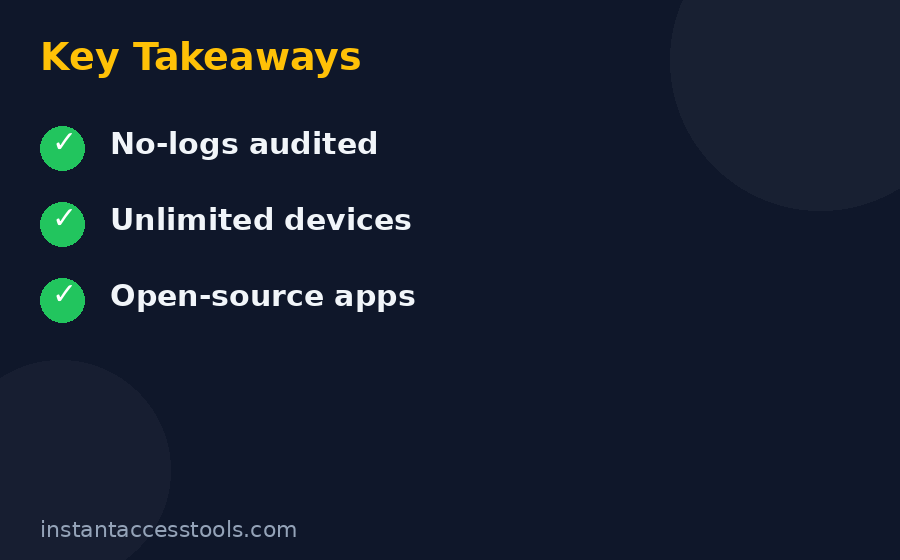
PIA’s whole identity is built around privacy and transparency. It maintains a strict no-logs policy, publishes regular transparency reports, and — unusually — all of its apps are fully open source, so independent researchers can audit the code. It also offers one of the largest raw server networks in the industry, with servers in 91 countries at last count, and supports unlimited simultaneous connections on a single subscription.
The question this private internet access review keeps circling back to is whether that privacy-first philosophy still compensates for an app interface that feels more “engineer’s tool” than “consumer product.”
Private Internet Access Review: Features I Actually Tested
PIA VPN Speed: Fast Enough, But Not Class-Leading
Let’s start with the question everyone asks: pia vpn speed. Speed matters because a VPN that halves your connection ruins everything from video calls to downloads, and PIA’s results were… good, with caveats.
I ran speed tests at different times of day on three connection types: a nearby server (under 500 miles), a mid-distance server across the continent, and a long-distance server on another continent. Testing protocol was WireGuard where available (it’s PIA’s default now) with OpenVPN as a comparison.
- Nearby servers: Roughly 85–92% of my baseline speed retained. Plenty fast for 4K streaming, gaming, and large downloads.
- Mid-distance servers: Around 70–80% retention. Noticeable but fine for everyday use.
- Long-distance servers: 55–70% retention depending on the route and time of day. Fine for browsing and HD video; I wouldn’t rely on it for competitive gaming.
Latency increased as expected with distance, which is physics, not a PIA flaw. Compared to the fastest VPNs on the market, PIA sits a tier below the absolute leaders — NordVPN and a couple of others consistently edge it out on long-distance throughput. But for most real-world use, PIA is comfortably fast. If you’re on a typical 100–200 Mbps home connection, you won’t feel the difference in daily browsing.
One genuine strength: PIA’s speed was consistent. Some VPNs spike fast on their best server and crawl on others; PIA’s network felt evenly provisioned, so switching servers didn’t produce nasty surprises.
Server Network and Locations
PIA doesn’t publish an exact server count anymore, but it advertises servers in 91 countries — one of the broadest country coverages in the industry. It also offers servers in all 50 US states, which is genuinely useful if you need a specific state IP for regional content or work tools.
Server variety includes:
– Standard VPN servers in every location
– Streaming-optimized servers in select countries (more on streaming below)
– Multi-hop routing for extra privacy
– Dedicated IP available as a paid add-on
– Port forwarding support, which torrenters and some gamers care about
Having this many locations is great for bypassing geo-blocks and finding a fast nearby server wherever you travel.
Privacy, Security, and the No-Logs Promise
This is where PIA shines brightest. Privacy credentials include:
- Strict no-logs policy, audited independently multiple times
- Open-source apps on every platform — you (or an expert you trust) can inspect the code
- RAM-only servers, so data can’t be physically stored long-term
- Transparency reports published regularly, documenting requests from authorities
- Court-proven record: PIA has been subpoenaed in legal proceedings and had no logs to hand over — a claim few competitors can make with actual documentation
- WireGuard, OpenVPN, and IPSec protocols with configurable encryption levels (AES-128 for speed, AES-256 for maximum security)
- Kill switch on desktop and mobile, plus an advanced kill switch that blocks all traffic until the VPN connects
- MACE ad/tracker/malware blocker built into the apps
- Split tunneling on desktop and Android
- Custom DNS options including PIA’s own private DNS
The elephant in the room: PIA is owned by Kape Technologies, and some privacy purists remain uneasy about the 2019 acquisition given Kape’s history in a different era of the ad-tech business. My honest take: the open-source apps, RAM-only infrastructure, independent audits, and documented no-logs record are stronger evidence than ownership rumors. If corporate ownership is a dealbreaker for you, proton vpn review covers a VPN from a company with a cleaner privacy-origin story — though you’ll pay more for it.
Streaming Performance
Here’s where I have to be blunt. Streaming is PIA’s weakest category. Its dedicated streaming servers worked for:
– Netflix US on most attempts (occasional detection errors, usually fixed by switching servers)
– A few other major platforms with mixed reliability
But regional Netflix libraries outside the US, and several other popular streaming services, were hit-or-miss. If streaming is your primary reason for buying a VPN, PIA will frustrate you. surfshark vpn review covers an option that’s cheaper than most rivals and notably better at consistent streaming unblocks, and cyberghost vpn review covers another Kape stablemate with servers specifically labeled for each streaming service.
That said, if streaming is a secondary use case for you — something you want available, not something you depend on daily — PIA’s streaming servers are fine as a bonus rather than a headline feature.
Apps and Usability
PIA’s apps are functional and extremely configurable, which is both the appeal and the problem. The desktop app lets you tweak encryption cipher, handshake method, MTU size, port, DNS, kill-switch behavior, automation rules per network, and more. Power users will love it. Beginners may feel like they opened a cockpit panel.
Positives:
– Clean connection flow: pick a location, hit the big connect button
– Consistent interface across Windows, macOS, Linux, Android, iOS, and browser extensions
– Excellent Linux support (GUI app, not just command-line) — rare among big VPNs
– Unlimited simultaneous connections on every plan
– Quick-connect and favorites for your most-used servers
Negatives:
– The settings depth can overwhelm new users
– iOS app is more limited than Android/desktop (no split tunneling, fewer protocol options)
– The design language feels dated next to competitors that have redesigned in recent years
Torrenting
PIA is one of the best VPNs for torrenting, full stop. Port forwarding (declining in the industry) is still supported, P2P is allowed on all servers, speeds held up well in my download tests, and the kill switch plus no-logs policy give you the safety net that matters. If your main use case is P2P, PIA belongs on your shortlist.
Private Internet Access Review: PIA VPN Pricing Breakdown
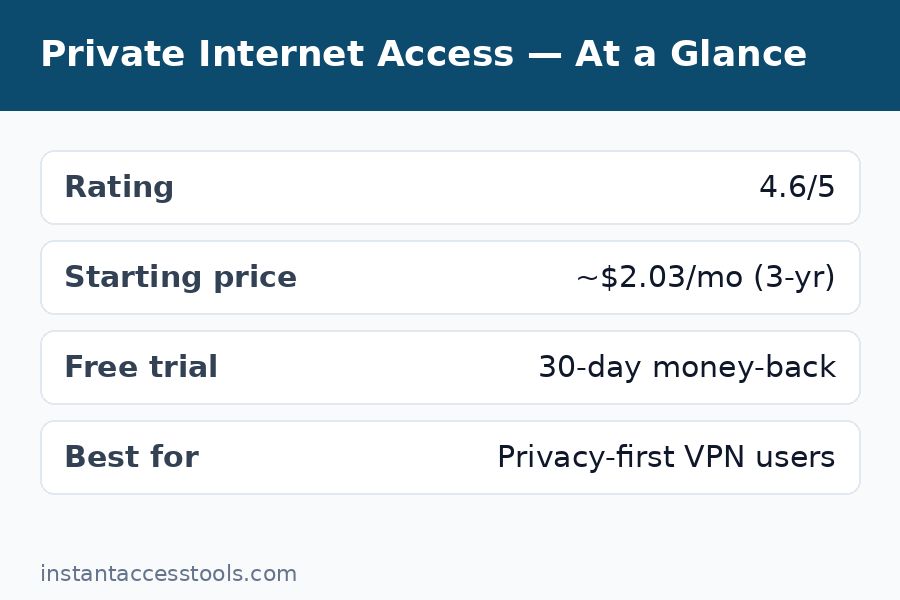
Pia vpn pricing is one of PIA’s strongest selling points. The pricing model is simple — three tiers based on commitment length, all with identical features:
- 1 month: The most expensive per-month option, best for short-term needs. Typically starts at around $11.99/month at the time of writing — check the official site for current pricing.
- 1 year: A middle tier that cuts the monthly equivalent substantially. Usually around $3.33/month billed annually at the time of writing — check the official site for current pricing.
- 3 years: The flagship deal, and the one PIA pushes hardest. Historically around $1.98/month (sometimes $2.03/month depending on the promotion) billed for the full term at the time of writing — check the official site for current pricing.
Every plan includes all features, unlimited devices, and a 30-day money-back guarantee. There’s no feature-gating between tiers, which I appreciate — some competitors reserve their best tools for longer plans.
One pricing caution: like most VPNs, PIA’s headline price is an introductory rate. Renewals are billed at the then-current standard rate, which can be noticeably higher than the deal you signed up with. Always check the renewal terms on the checkout page before you buy.
👉 See PIA’s current plan pricing
Is There a PIA VPN Free Trial?
The honest answer about a pia vpn free trial: PIA doesn’t offer a traditional free trial on desktop the way some competitors do. What it offers instead is a 30-day money-back guarantee, which functions as a risk-free trial — you pay upfront, test everything for a month, and get a full refund if you’re not happy.
Mobile users have historically been able to get a short free trial through the app stores (usually 7 days on Android via Google Play). Availability of that trial varies by region and over time, so check the listing in your app store.
My advice: the 30-day guarantee is actually more useful than a typical 7-day trial because it gives you time to test speeds across different networks, try streaming, and use it on all your devices. Just set a calendar reminder a few days before day 30 so you don’t sleep through the refund window if you decide it’s not for you.
PIA vs NordVPN: The Matchup That Matters
The pia vs nordvpn comparison is the one I get asked about most, because these are the two VPNs that end up on almost every shortlist. Here’s how they stack up:
| Category | PIA | NordVPN |
|---|---|---|
| Monthly price (typical) | Lower on long-term plans | Higher, but frequent deals |
| Speed | Good, consistent | Faster on long-distance routes |
| Server countries | 91 | 150+ |
| Simultaneous connections | Unlimited | 10 |
| Streaming reliability | Mixed | Excellent |
| Open-source apps | Yes, all platforms | Partially |
| Ease of use | Technical, configurable | Polished, beginner-friendly |
| Torrenting | Excellent (port forwarding) | Excellent (specialty servers) |
| Audits | Yes, multiple | Yes, multiple |
Choose PIA if: budget matters most, you want unlimited devices, you’re a tinkerer who likes open-source transparency, or torrenting is the priority.
Choose NordVPN if: streaming is the main event, you want the fastest possible speeds, or you prefer a polished app that “just works” with minimal decisions.
Neither is a bad choice — they’re aimed at slightly different buyers. For a deeper dive on the alternative, check out our full surfshark vpn review, which often undercuts both on price.
PIA Pros and Cons
Here’s the full pia pros and cons rundown after my testing period:
Pros:
– Excellent privacy pedigree: open-source apps, RAM-only servers, audited no-logs policy with a court-proven track record
– Unlimited simultaneous connections — cover every device you own on one plan
– Huge server network across 91 countries, including all 50 US states
– Highly configurable for power users (encryption levels, protocols, split tunneling, port forwarding)
– Strong torrenting support with port forwarding still available
– Very competitive long-term pricing
– Reliable, consistent speeds for everyday use
– MACE ad/tracker blocker included at no extra cost
Cons:
– Streaming unblocks are inconsistent — not the best pick for streaming-first buyers
– Interface can overwhelm beginners with its depth of settings
– iOS app is less capable than the desktop and Android versions
– Owned by Kape Technologies, which bothers some privacy purists (though evidence supports the no-logs claims)
– Renewal pricing jumps after the introductory term
– Speed, while solid, isn’t class-leading on long-distance connections
Is PIA Worth It? Who Should Buy
So, is pia worth it in 2026? For the right buyer, absolutely. PIA is worth it if:
- Privacy is your top priority. The combination of open-source code, independent audits, RAM-only servers, and a documented no-logs history is genuinely best-in-class.
- You torrent regularly. Port forwarding, P2P on all servers, and a real kill switch make PIA a torrenting workhorse.
- You have lots of devices. Unlimited connections means one cheap long-term plan covers your phone, laptop, tablet, smart TV, and your family’s devices too.
- You’re a Linux user or a tinkerer. Few VPNs treat Linux and advanced configuration this well.
- You’re budget-conscious. The 3-year deal is among the cheapest per-month prices from any reputable VPN.
PIA is probably not worth it for you if streaming reliability is non-negotiable, you want the simplest possible app, or the Kape ownership is a hard line for you regardless of the technical evidence.
For most privacy-focused buyers, my answer is yes — it’s still good, still cheap, and still one of the most transparent VPNs you can buy. That was true before this private internet access review started, and my testing confirmed it.
Frequently Asked Questions
How much does PIA VPN cost?
PIA’s pricing depends on the plan length. The monthly plan starts at around $11.99/month at the time of writing, while the 1-year and 3-year plans bring the monthly equivalent down significantly — the 3-year deal has historically been under $2.10/month. All plans include identical features and unlimited devices. Prices are introductory rates, so check the official site for current pricing and renewal terms.
Does PIA offer a free trial?
PIA doesn’t offer a standard desktop free trial. Instead, every plan comes with a 30-day money-back guarantee, which works as a risk-free trial period. Mobile users may find a short trial (typically around 7 days) through the Google Play or Apple App Store, though availability varies.
Is PIA faster than NordVPN?
In my testing, NordVPN was faster than PIA on long-distance connections, while the two were closer on nearby servers. PIA’s speeds were consistent and perfectly adequate for streaming, browsing, and downloading — but if raw speed is your top criterion, NordVPN edges it out.
Is Private Internet Access safe to use?
Yes. PIA uses AES-256 (or configurable AES-128) encryption, WireGuard and OpenVPN protocols, a kill switch, private DNS, and RAM-only servers. Its no-logs policy has been independently audited and tested in legal proceedings. All apps are open source for public inspection.
Can I use PIA for Netflix and streaming?
Sometimes. PIA’s streaming-optimized servers unblocked Netflix US in most of my tests, but other regions and platforms were inconsistent. If streaming is your main use case, consider a VPN with a stronger streaming record instead.
How many devices can I use with PIA?
Unlimited. Every PIA plan allows unlimited simultaneous connections, so you can protect all your devices — and your household’s — on a single subscription.
Final Verdict: Private Internet Access Review 2026
After weeks of testing, my conclusion for this private internet access review is straightforward: PIA remains one of the best-value VPNs on the market for privacy-conscious users. It’s not trying to be the prettiest app or the streaming champion — it’s trying to be the most transparent, configurable, and affordable serious VPN, and at that it succeeds.
The trade-offs are real: streaming is hit-or-miss, beginners face a learning curve, and the ownership question will keep bothering some people. But the core product — fast-enough speeds, a massive server network, genuine privacy engineering, unlimited devices, and pricing that undercuts nearly every rival — is as strong as it’s ever been.
If that sounds like your kind of VPN, the long-term plans are where the real value is:
👉 Get PIA at the current best price
Try it for 30 days risk-free, put it through your own routine, and decide with your own data. That’s the only review that really matters.